The forgetting
Chat AIs meet you again every morning. You re-explain your business, your clients, your taste, and the answer is good for exactly one tab. Close it, and the understanding is gone.
Private closed beta. Invites go out in waves.
A working team of AI agents, set up for you on your own dedicated server. Each takes a role in your business. They share one memory that compounds. You direct it all from your phone.
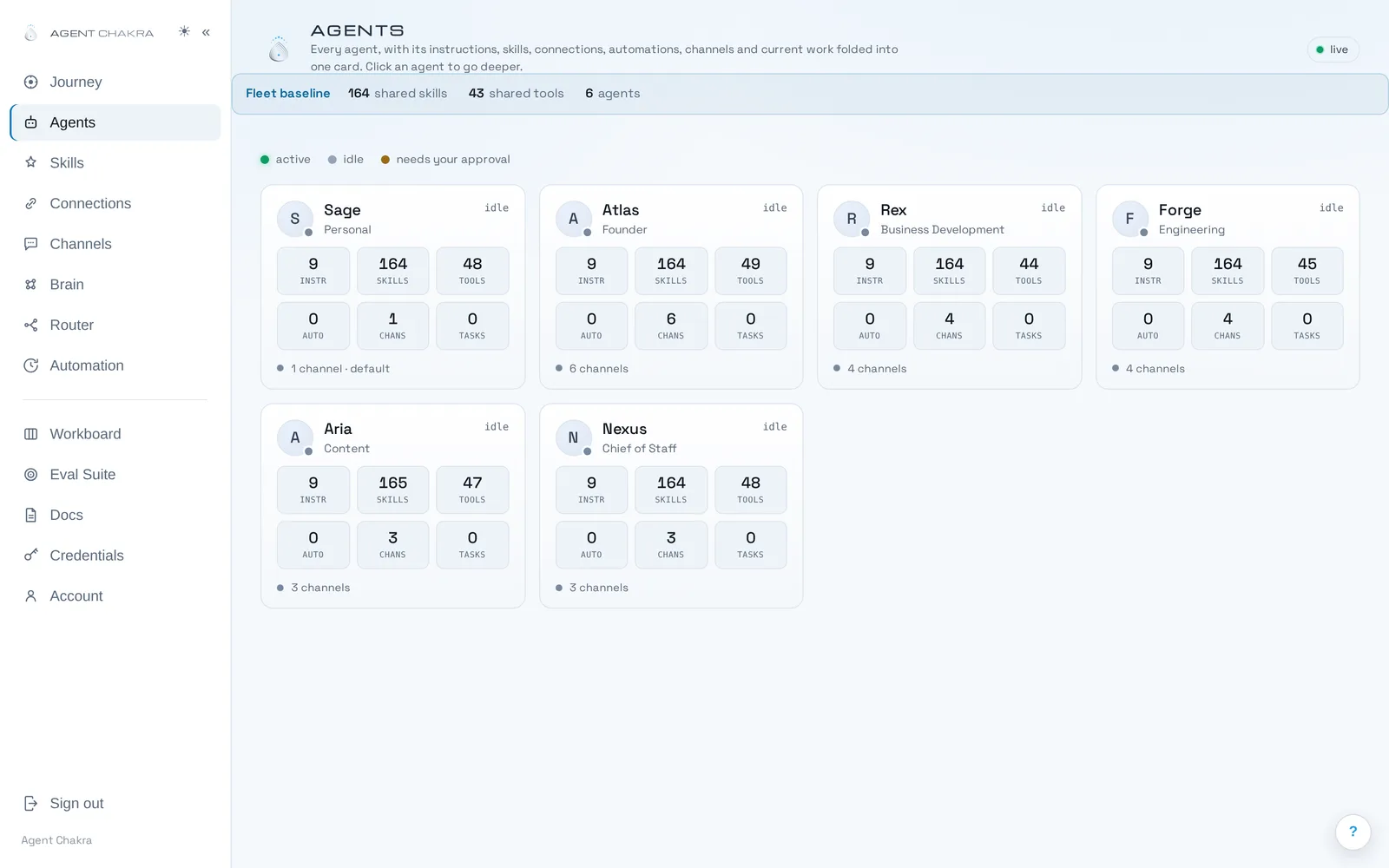
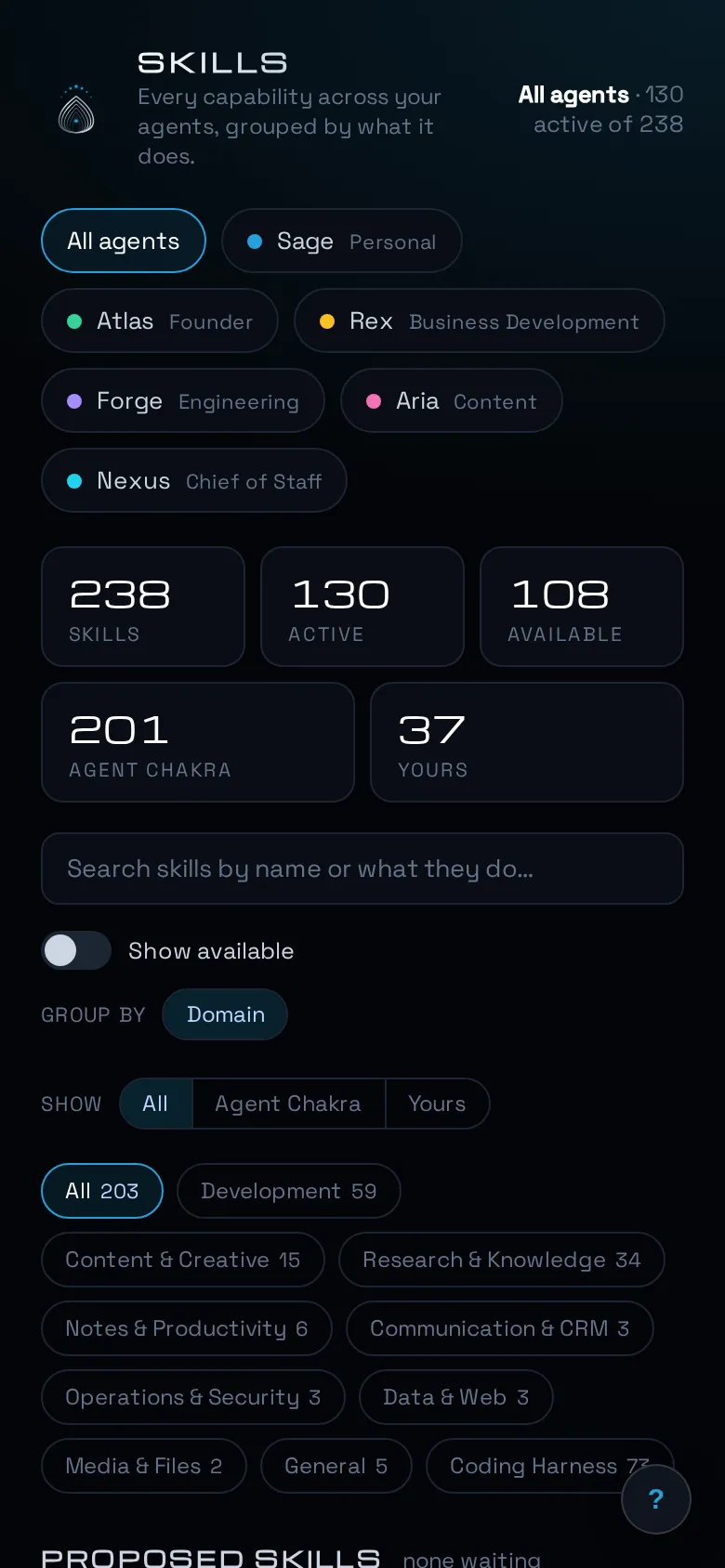
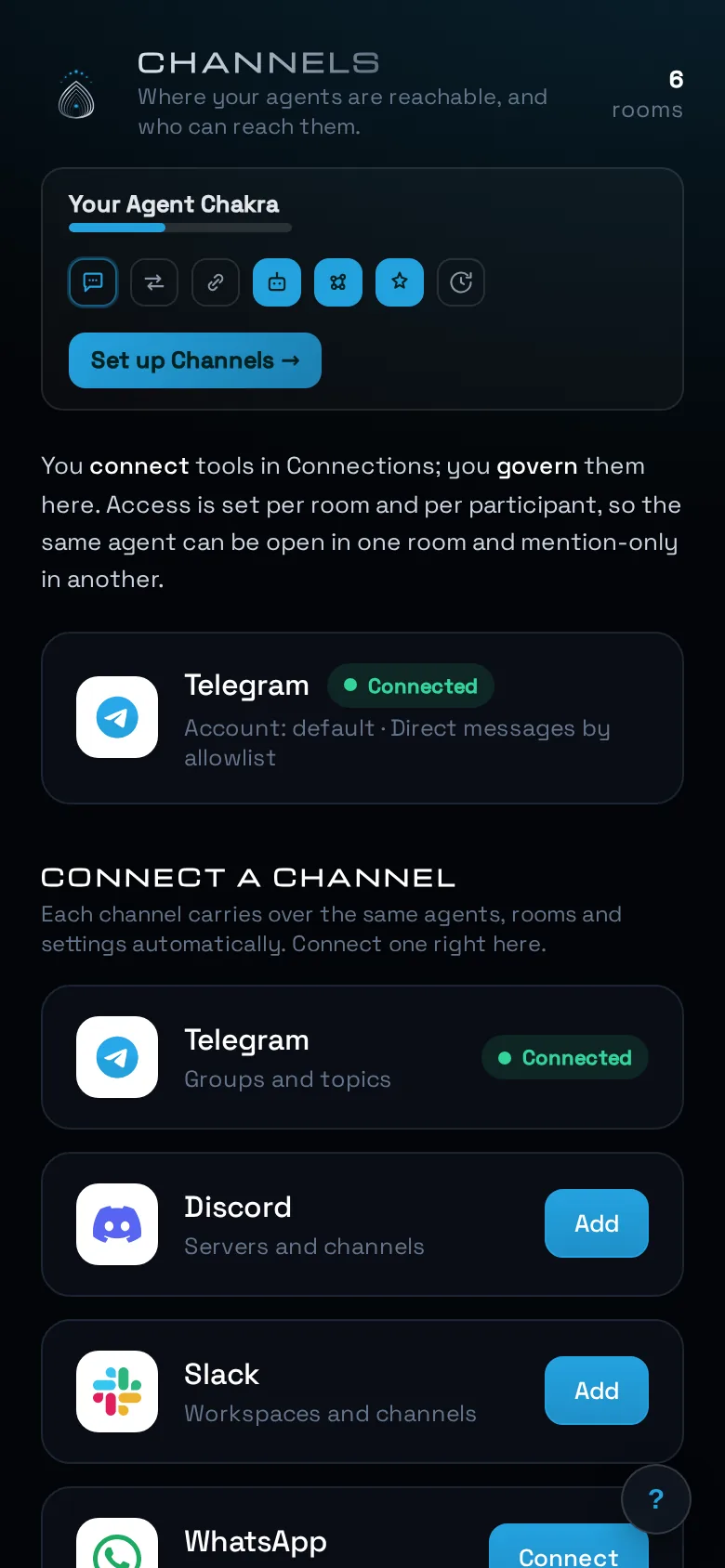
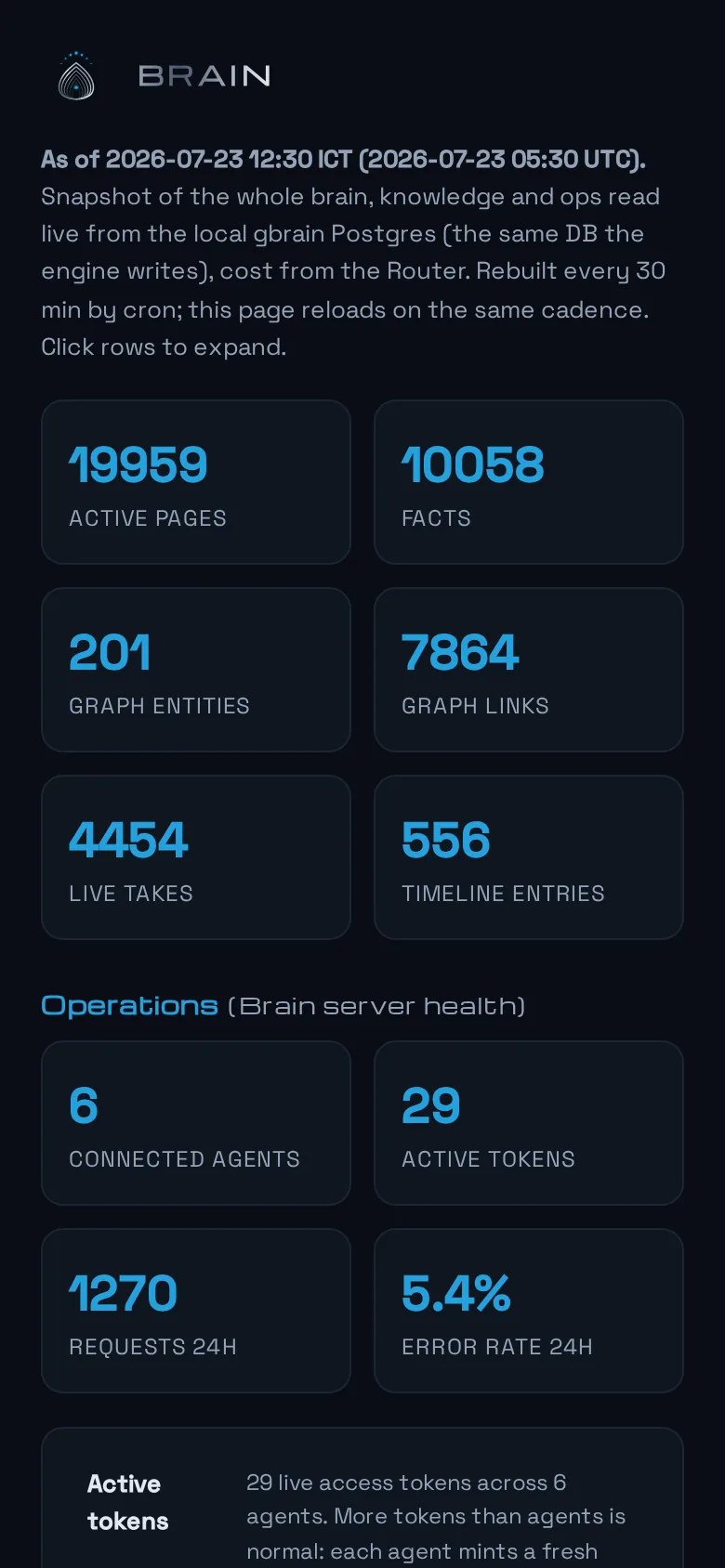
Watch it run Seven live views of a real box, one scroll below.
The product
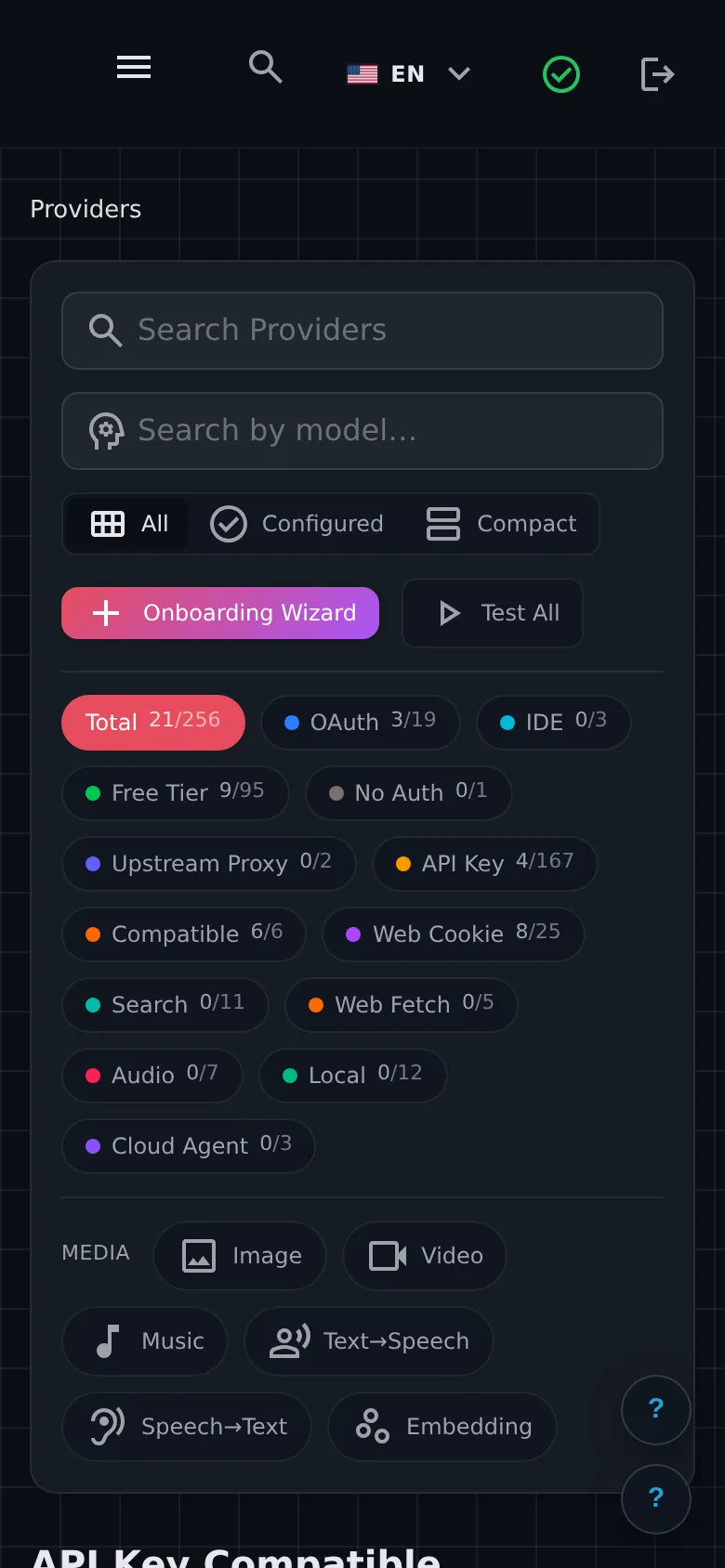
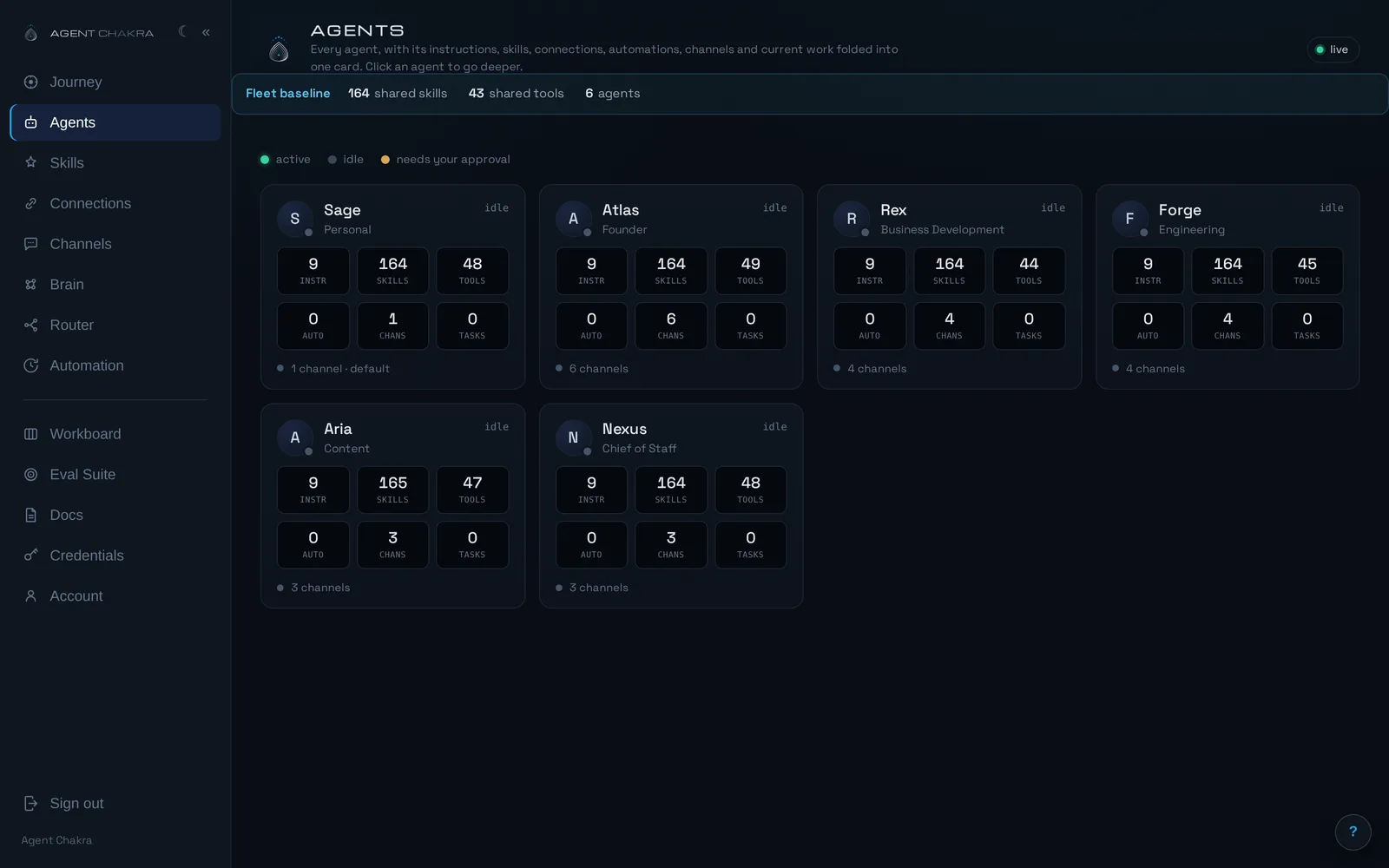
Real views of the founder's own box, captured live from the running console. Every name and number on screen is real; nothing is staged.



The problem
The models are extraordinary. The way most people have to use them is not.
Chat AIs meet you again every morning. You re-explain your business, your clients, your taste, and the answer is good for exactly one tab. Close it, and the understanding is gone.
So you add tools. Each one brings a login, a subscription, a policy that can change under you. Your context scatters across a dozen apps, and you become the only thing connecting them.
Everything you build lives on someone else's servers, under someone else's rules. If a provider raises prices or shuts a product down, your way of working goes with it.
The real limit is your attention: one brain, one thread of it, every role competing for that thread. What you need is not another tool. It is a team that carries your judgment, and a place of your own to run it.
What it is
Picture the open-source agent frameworks as a factory. Every machine you could ever need is on the floor, and the doors are wide open. The catch: you walk in alone, and working out what connects to what is your problem.
Agent Chakra is walking into that same factory after a pathfinder spent months inside with your exact goal. You inherit the findings. The configurations that work. The experiments that failed, so yours don't have to. The trail is already marked.
Your subscription is access to that trail, plus every finding the members after you add to it. And if you ever want your own keys to the factory, a perpetual license means exactly that.
The method
In the chakra tradition, well-being is seven centers working as one body. Same here: seven components, each one replaceable, none of them the system on its own. We call it the way of Chakra. Here is what happens when one message arrives.
The right agent answers.
Each agent holds one role: sales, operations, content, whatever your business runs on. Its own voice, its own scope, its own tools. To the outside world there is one identity: yours.
It knows how you do things.
Your procedures, written down once and improved with use. How you quote, how you write, how you follow up. Skills are portable knowledge, not code, and they move with you.
It reaches your actual tools.
Over 1,000 apps out of the box: email, calendars, docs, CRMs, the rest of your stack. Custom connections can be brought in too.
It lives where you already talk.
Telegram first; Slack and Discord for teams and communities. No new app to learn, no dashboard to keep open. Work arrives in chat, and your approve, edit, or reject is one tap.
Nothing you tell it is wasted.
One organized memory that grows as a side effect of working. Decisions, people, projects, corrections: captured with sources and dates, searchable by every agent, compiled into pages you can actually read. This is the asset. It compounds.
The right model for each job.
Many AI providers sit behind one routing layer. Simple work goes to cheap or free models; hard work gets the best available brain. Your agents never stop because one company had a bad day.
It works while you sleep.
Scheduled and background processes run around the clock, with a heartbeat that watches for what matters and only wakes the expensive thinking when it should. You review finished work in the morning instead of doing it at night.
Every message you send travels this path. Every path it travels makes the next one better.
How it starts
We provision a dedicated server for you. Not a shared platform: a server with your name on it.
Setup is a conversation, not a manual. Your first agent walks you through connecting your channels and tools. It takes minutes.
Agents come online around the roles you actually have. From then on, every day of use makes the system more yours.
The invite is the only step we cannot do for you.
Join the waitlistSovereignty
The people who get the most out of AI this decade will be the ones who own their setup. Not rent it. Own it. An AI woven into your business is too important to hang from any one company's pricing page.
Your real capital is not any tool. It is your data, your judgment, your accumulated context: what you know, how you decide, what you would never do. Agent Chakra makes that capital concrete, organized, and portable. Most people believe they already have this. Almost nobody does.
So every component is replaceable by design. Models can be swapped. The engine is open. The channels are adapters, not foundations. If the market shifts, you re-point one part and keep working. The system is built to outlive any vendor's decisions, including, frankly, ours.
You come in through a free trial. You can leave with everything: a perpetual license, self-hosting on your own hardware, and a full export of your workspace, your files, and your agents' entire memory. The full export lives in your account view: one click assembles it on your server and hands you a plain archive that opens anywhere. A system built on the rejection of lock-in does not get to lock you in.
Proof
Building this system, I cancelled roughly 90% of my own software subscriptions. The savings were the small part. The real change was the end of context switching between a dozen tools, each one a separate dependency with a mind of its own.

Fit
Agent Chakra is for people who run something real and refuse to accept that growing it must mean drowning in it.
And honestly, it is not for everyone.
Keep them. Agent Chakra does not replace any of these, and it does not compete with them.
ChatGPT and Claude are chat interfaces: brilliant in conversation, but the understanding lives in a tab, and nothing happens when the tab is closed. Claude Code and Codex are serious engineering tools that assume you are comfortable in a terminal. OpenClaw and Hermes are open agent frameworks: all the machinery is there, and assembling and operating it is up to you.
Agent Chakra is the operating layer on top of that machinery. We ship an open agent engine and run it for you, on a server of your own, arranged into a working team by the Chakra method, reachable in the chat apps you already use. If you have already built an agent in Claude Code, Hermes, or elsewhere, you bring it in and it keeps what matters. Nothing you use today has to lose for this to work.
No. Setup is a guided conversation with your first agent, and daily use is chatting in Telegram, Slack, or Discord. If you do have technical skills, there is plenty of depth to go find. None of it is required.
A real server, provisioned for you alone. Not a shared platform where your work sits in someone else's database next to everyone else's. Your agents, your memory, and your files live on it, we keep it running and updated, and if you ever choose the self-hosted path, the same system runs on hardware you control.
It leaves with you. A full export of your workspace lives in your account view: your agents' memory, your files, everything the system knows, assembled on your server into one archive that opens with standard tools. Beyond export, there is a perpetual license and a self-hosting path, so leaving our subscription never means abandoning your system.
You keep working. Models reach your agents through a routing layer that spans many providers, so a price change, policy shift, or outage at one company means the router leans on the others. That resilience is a founding design law of the system, not a feature we added later.
Pricing is shared with your invite, before you commit to anything, and every membership starts with a free trial. We publish no price during the closed beta because the offer is still being shaped with the beta cohort, and we would rather tell you a settled number than a moving one.
Invites go out in waves, in waitlist order. The beta cohort is deliberately small, and each wave is sized by what we can onboard well, not by a growth target. Your confirmation email is your place in line; we will tell you when your wave is next.
A consultant engagement can run past $5,000 and still leave you dependent on the person who built it. Agent Chakra is a product: the setup knowledge is built in, the system maintains itself, updates arrive tested, and improvements discovered across the member base flow to everyone. You are buying a marked trail, not a one-off construction.
Private closed beta. Invites go out in waves.
The beta cohort is deliberately small: we would rather run a few systems flawlessly than many badly. The waitlist is the queue every invite comes from. Joining takes one field.
You will get one email confirming your spot. It includes the seven-part checklist we build every system around; it is worth having even if you never join.